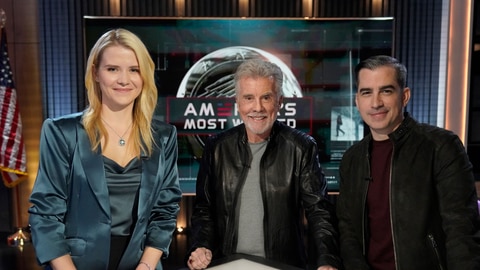
America's Most Wanted and the Boston Herald have teamed up to uncover exclusive information about the largest art theft in U.S. history. While the 13 artworks are still missing, new information is bringing the F.B.I. and the Isabella Stuart Gardner Museum closer to cracking the caper.
And for the first time, the Herald has commissioned a medical artist to work with one of the guards who was on duty the night of the heist to come up with new images of what the suspects may have looked like.
But the central question remains: where is the stolen art?
On the morning of March 18, 1990, thieves disguised as police officers broke into Boston's Isabella Stewart Gardner Museum and stole 13 works of art valued at more than $500 million. It is the biggest property theft in United States history.
Two men dressed as Boston police officers -- complete with authentic uniforms, badges, and radios -- demanded entrance to the museum because they, "got a call about a disturbance."
Despite explicit instructions to the guards to, "not even let God himself inside the museum," the men dressed as officers were let inside, where in just minutes, they coaxed the first guard out from behind his desk and away from the silent alarm that, when pressed, called the real police to the museum.
Once the second guard joined his partner downstairs, the faux cops claimed the guards were wanted men -- and promptly handcuffed them and duct-taped their mouths. Then they bound the guards 40 yards apart in the basement while they followed through on their historic plan.
The thieves were undeniably familiar with the interior of the museum, spending nearly an hour and a half walking inside it, seemingly unafraid that Boston Police might crash their pillaging party. During the Heist, the thieves made off with works by Rembrandt, Degas, and Manet to name just a few.
Just days after the 1990 heist, America’s Most Wanted -- then a new crime show on the new FOX network -- went inside the museum with the FBI to recreate how the crime took place. To this day, museum staff use video of the recreation to train its security staff.
Now, nearly 20 years later, no one has been arrested in connection with the Heist, and the artwork has never been located.
From the beginning, theories abound: Was the work taken to fund international terrorism? Was it sold for a large amount of drugs? Was the infamous mobster Whitey Bulger involved? Finally, some answers are coming to light, but there's still no hint of where the art is hidden.
Breathing New Life Into The Investigation
Three years ago, the Museum hired a man named Anthony Amore to head up the investigation into the stolen art. Amore had worked at the Department of Homeland Security, helping to rebuild security at Boston’s Logan airport after 9-11.
Amore has helped put into place several security measures, to ensure nothing like this ever happens again.
But, Amore’s top priority is finding the art work.
“Someone knows who did this, and where the art is and I won’t rest until I find out,” Amore told AMW Correspondent Jon Leiberman. Amore has spent thousands of hours, analyzing data – pouring over hundreds of pages of documents, and talking to members of the public, all in an effort to solve the caper.
Without any fruitful leads, Amore knew he had to try a new approach. That’s when he called Boston Herald reporter Tom Mashberg.
Mashberg had spent more time and resources digging into the Heist than any other journalist in Boston, reporting on it for the better part of 15 years.
Amore and Mashberg determined that working on new composite photos of the suspects could breathe new life into the investigation.
So, the pair brought artist Nicole Wolf in. Amore set up a secret e-mail account that one of the guards on duty the night of the break-in would use to e-mail back and forth with Wolf about what the suspects looked like.
After months of back and forth -- and dozens of e-mails -- Wolf came up with new drawings of the two suspects.
Several months after Amore and Mashberg joined forces, an inmate in prison for murder wrote them a letter.
That man, Robert Beauchamp, claimed that his former lover -- a man named George Reissfelder -- told him way back in 1990 that he had taken part in the heist.
Beauchamp met George Reissfelder when they did time together in the 1970s. The men became close, and even escaped and lived together in 1974. Both were captured, and sent to separate prisons outside Massachusetts in 1977.
The men stayed in touch despite the distance.
In 1982, Reissfelder's conviction was overturned, and he was freed from prison. When Beauchamp was finally returned to a Massachusetts prison in 1987, the two men were in regular contact. From 1987 to 1991, Reissfelder visited Beauchamp in prison more than 100 times, and sent him hundreds of correspondences.
A Brazen Plan Unfolds
It was during this time that Beauchamp claims he urged Reissfelder to steal a painting, a useful bargaining chip should Reissfelder or his crew ever get pinched for any of their other alleged criminal activities.
Though he didn't specifically suggest the Gardner, Reissfelder and his associates began plotting the caper, and, according to Beauchamp, pulled off the nation's biggest art heist on March 18, 1990.
Beauchamp also claimed that he had knowledge of addresses in Maine where Reissfelder may have hidden the art.
“George told me he hit the jackpot,” Beauchamp told AMW’s Jon Leiberman in a 2009 jailhouse interview. “But he was careful how much he told me because we knew our conversations were being monitored."
Nearly a year to the day after the heist, Reissfelder died of a cocaine overdose in his Boston-area apartment.
Beauchamp believes Reissfelder moved the art after initially storing it, but didn't reveal the location to anyone before his death.
In 2008, Beauchamp asserted in an affidavit that he knew who perpetrated the heist and where the art might be hidden.
At first, investigators were intrigued by Beauchamp’s information. But after the FBI and Amore went to several addresses searching for the stolen art and came up empty–handed, their faith started to fizzle.
Then, another strange thing happened: Reissfelder’s brother came forward. In an interview with America’s Most Wanted, Richard Reissfelder said, “I have seen that Chez Tortoni painting, and it was on the wall in my brother’s bedroom. I am sure of it.”
$5 Million For The Taking, No Questions Asked
Anthony Amore says we may never know who perpetrated the Heist, but George Reissfelder is at the top of the list. Amore's top priority now is finding the art. The museum continues to offer a $5 million reward for information leading to the recovery of the art.
Amore has paint chips -- the paintings' chemical DNA -- which he can use to positively authenticate the paintings when they are found. Amore wants everyone to take a close look at all of the pieces of art and e-mail tips to AMW.com, or call 1-800-CRIME-TV. Then, view the interactive sketches of the suspects on the Boston Herald's website at bostonherald.com.
Amore has a quote from museum director Anne Hawley that he keeps on his desk: "I hope I live to see the day!"
And with those words, Anthony is constantly reminded of his mission.